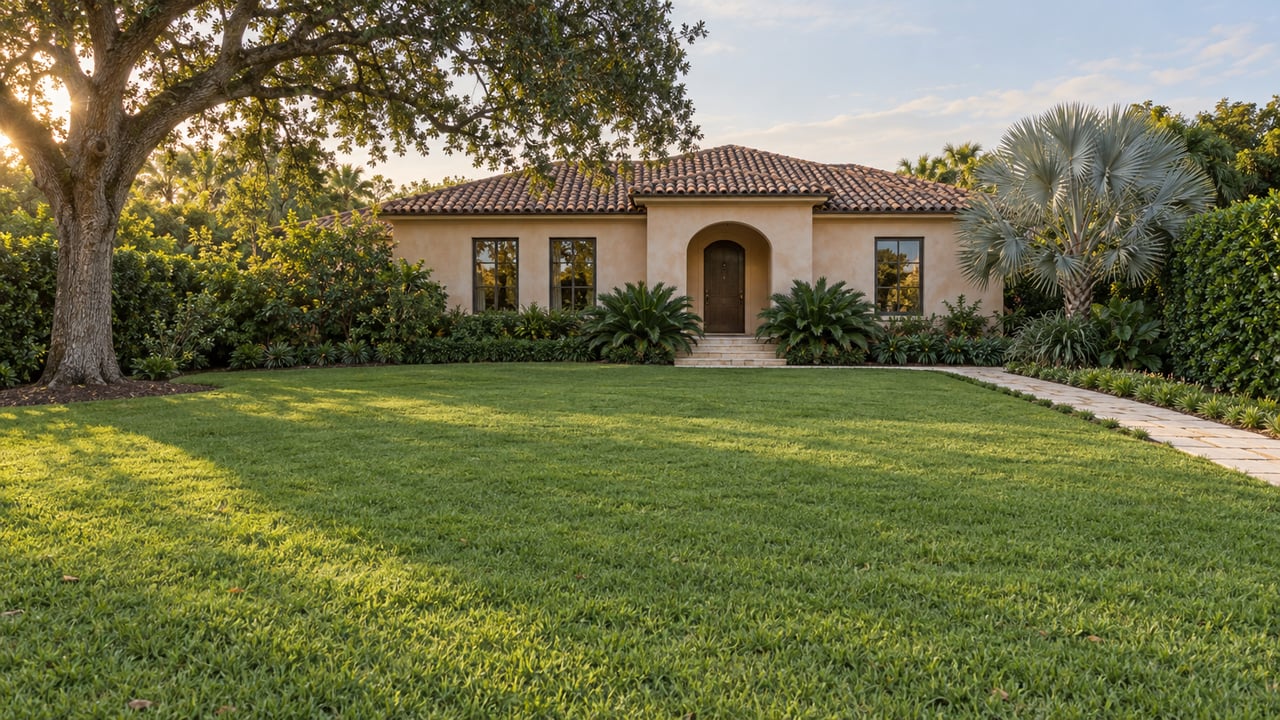
An 11,700-square-foot spec home on Chapman Field Drive closed at its full $16.3 million asking price in early September 2026, the same week Miami-Dade's weekly count of luxury contracts countywide dropped to just 12. Condo buyers across the county were gaining room to negotiate. Single-family sellers in Pinecrest were not giving any of it back.
That gap is not a coincidence and it is not really about the house. A buyer comparing Pinecrest to Coral Gables, South Miami, or Palmetto Bay on portal medians alone is comparing the wrong number. One factor that helps explain Pinecrest's pricing sits in the village's zoning code, not its listing sheets: a one-acre minimum lot requirement, in place since incorporation, that applies to most residential parcels and limits how many homes can be built on those parcels. Much of what we see in this market, the way old ranches price against new construction, the quiet split between the north end and the south end of the village, the fact that Pinecrest kept its multiple-offer competition while the rest of the county's luxury segment cooled, traces back to that constraint.
What the zoning map actually locks in
Pinecrest's housing stock runs nearly seventy years deep, from the original 1950s and 1960s ranch houses that established the acre pattern through to homes finished this year. The acre lot itself, not the era of construction on it, is the fixed asset. The village's estate zoning district requires that one-acre minimum on most residential parcels, and the Village Council's own comprehensive planning documents make clear that low density has been the guiding principle since Pinecrest became its own municipality. You can read the underlying code yourself in Pinecrest's official ordinances, filed with Municode, but the practical upshot for parcels subject to that rule is simple: they cannot be subdivided to create more inventory. New supply on those parcels means a teardown and a rebuild on an existing acre, not a new acre carved out of an old one.
That is a different kind of scarcity than a hot market running short on listings for a season. For parcels subject to that rule, it is a long-term limit on unit count that can put pressure on prices.
The gap between the average and the median
Active single-family listings in Pinecrest carried a median asking price of $4.7 million as of July 21, 2026, according to a market report compiled from Southeast Florida MLS data. The average asking price for that same pool of listings was $6.1 million, a full $1.4 million higher. That spread is not statistical noise. A handful of estate listings at the very top of the market, priced well above $10 million, pull the average up without moving what a typical Pinecrest buyer is actually competing for. The median is the number worth anchoring to, and even that median sits on a typical lot of about 0.85 acres, with the typical active listing built around 1997 and asking roughly $987 per square foot.
Inside that per-square-foot number is the clearest evidence for the acre thesis. Older homes on strong lots trade well below the per-foot median, because buyers are pricing the land and treating the structure as a renovation project. New construction on an equivalent lot commands a premium that can run close to double the median per-foot figure, because it delivers something the acre alone cannot: current wind-load code compliance in a High-Velocity Hurricane Zone, impact-rated glazing, and documented system ages that make insurance underwriting straightforward. Two listings at an identical price in Pinecrest can represent very different value depending on whether that price is buying land, a livable structure, or both.
| Snapshot | As of | Price signal | Pace |
|---|---|---|---|
| MLS-based active listings report | July 21, 2026 | Median list $4.7M, average $6.1M, ~$987/sq ft | Not reported |
| Village-wide active listing summary | August 2026 | Average sale price $4,386,000, 127 active listings | 79 days average on market |
Both snapshots describe the same village within weeks of each other, and both point the same direction: a market where the land under the house, not the house, sets the floor.
A second price axis the village-wide median hides
Pinecrest is not priced uniformly north to south. A buyer whose non-negotiable requirement is a detached guest structure, a pool, a sport court, and a motor court on one parcel is really asking for acreage, and that acreage sits disproportionately toward the village's southern half. A buyer whose binding constraint is drive time to Coral Gables or Coconut Grove is asking for location, and that puts them toward Pinecrest's northern edge, often trading some lot size for proximity. Neither preference is wrong, but they describe two different products wearing the same village name, and a single village-wide median flattens that distinction into invisibility. Running comparables against the specific program you actually need, guest house or golf-club proximity, tells you more than any headline number the portals publish.
Pinecrest sits roughly 11 miles southwest of downtown Miami and is inland, not on Biscayne Bay, so the waterfront risk questions that dominate Miami real estate conversation generally apply unevenly here. Flood zone designations do vary within the village, particularly along the Snapper Creek corridor, which means the acre a buyer is pricing is not interchangeable even within Pinecrest's own borders.
Why the market's slowdown has skipped this zip code
Miami-Dade logged 847 closed sales priced at $1 million or above in the first quarter of 2026, and cash accounted for roughly 58 percent of those transactions. That cash concentration has kept pressure on tight single-family inventory in enclaves like Pinecrest even as the broader pace of luxury contracts across the county eased toward the end of August 2026. Financed buyers feel rate movement. Cash buyers, who make up more than half of this segment, largely do not, and Pinecrest's acre-lot buyer pool skews toward exactly that kind of purchaser.
The village's luxury single-family sales in 2025 typically closed between 91 and 93 percent of original list price, even as carrying periods stretched longer. A full-price contract on an $16.3 million spec home in September 2026 reads as unusual against that backdrop, not because Pinecrest buyers don't negotiate, but because the acre-lot supply constraint gives sellers here more room to hold a number than sellers in condo-heavy submarkets currently working through a buyer's market.
The ballot question that changes the math for one kind of buyer
According to Hoodline, Florida currently caps annual property tax assessment increases at 10 percent for non-homestead properties, with that cap resetting to full market value the moment ownership changes hands. A statewide constitutional amendment on the November 2026 ballot, Amendment 3, would lower that non-homestead cap to 5 percent starting in 2027. For a buyer purchasing a Pinecrest acre lot as a non-homestead property, that lower cap changes long-term carrying-cost projections. Whether the amendment passes and how it plays into 2027 purchase decisions remains an open question, but it belongs in the underwriting conversation now for anyone weighing a non-homestead purchase in a village where investment and spec activity are already a visible part of the market.
A short FAQ
Does the one-acre minimum apply to every lot in Pinecrest? The estate zoning district that carries the one-acre minimum covers most of the village's residential parcels, but Pinecrest's zoning map includes multiple districts. Anyone comparing two specific addresses should confirm each parcel's actual zoning designation before assuming the acre minimum applies uniformly.
Is the north-south price split something a buyer can see on a listing sheet? Not directly. It shows up in lot size and drive-time patterns rather than in any single field on an MLS printout, which is exactly why it goes unnoticed by anyone comparing villages purely on median price.
Does Amendment 3 affect homestead buyers too? No. The measure on November's ballot targets the non-homestead assessment cap specifically.
If you are weighing a Pinecrest acre against a comparable lot elsewhere in Miami-Dade, or trying to figure out whether a specific address sits on the land-value side of this market or the structure-value side, Pilar Ruiz Homes can walk the comparables with you street by street. Schedule a private consultation with Pilar before you write an offer on either kind of lot.
This article is general information, not legal, tax or financial advice. Consult a qualified professional about your situation.
