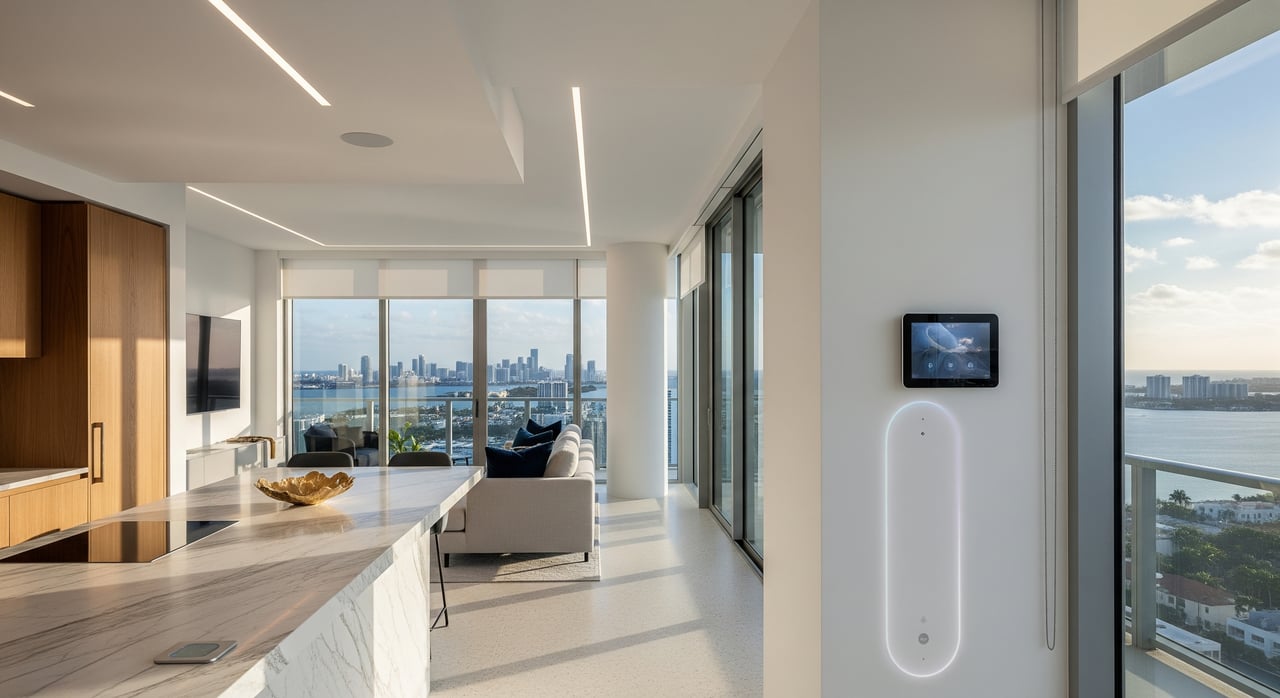
If you own a condo in Brickell, you know the lifestyle is effortless until a small issue disrupts your day. A missed delivery, a leak from an upstairs neighbor, or an AC glitch can become a headache fast. The right smart-home upgrades help you stay in control, protect your investment, and work smoothly with your building’s systems and concierge staff. In this guide, you’ll learn which devices fit Brickell high-rises, how to stay compliant with condo rules, and the simple steps to get approvals and install with confidence. Let’s dive in.
Why Brickell condos need smart planning
Brickell is packed with high-rise buildings that rely on shared corridors, concierge lobbies, and centralized mechanical systems. That means your choices for locks, leak detection, and climate control need to be building-friendly and reversible. Many new towers also have stricter rules about changes to door hardware, plumbing, and HVAC.
Miami-Dade’s hot, humid climate and summer storms create added risks. Hurricane season runs June through November. High humidity and heavy rainfall increase the chance of water intrusion, AC moisture issues, and plumbing leaks that can affect multiple units. Smart devices that detect problems early and streamline access save time, stress, and money.
Before you install anything, review your building’s declaration, bylaws, and house rules. Florida condominiums are governed by state law and building documents. Many associations require written approval for devices that touch doors, electrical, plumbing, or shared systems. It is also common for buildings to require an emergency key or a documented override for management.
Smart locks that fit condo rules
Smart locks are one of the best upgrades for day-to-day living in a Brickell high-rise. The key is choosing a lock that preserves building security, supports emergency access, and does not alter your door’s exterior appearance.
Building-friendly criteria
- Non-invasive or reversible installation that keeps the exterior hardware unchanged.
- Physical key backup and compatibility with your existing cylinder or master-key system.
- Documented emergency override so management can access the unit per condo rules.
- Multi-admin roles and audit logs so you can track entries and issue time-limited codes.
- Wireless protocol that fits your preference and building policies. Z-Wave or Bluetooth support local control. Wi-Fi offers wider remote control but often relies on cloud services.
- Fire and egress compliance. Do not install anything that impedes safe exit.
Device types that work in condos
- Retrofit interior-mount modules that attach to the inside of your existing deadbolt and preserve your exterior key.
- Smart deadbolts that accept a physical key cylinder and maintain master-key compatibility.
- Building-managed platforms, such as ButterflyMX, Kisi, or Brivo. Some buildings use these for visitor access and may support integration with in-unit locks. Always confirm what your building supports.
Owner steps for smart locks
- Read condo rules for door hardware and master keys.
- Ask management about emergency access requirements and whether they need a key or code.
- Choose a reversible product that keeps your exterior cylinder or clearly supports master-key compatibility.
- Provide product specs and an installation plan to the board or ARC for written approval.
- Set up admin roles, guest codes, and concierge access as allowed. Enable audit logs.
Leak sensors and shutoffs to prevent damage
Water damage is one of the most expensive condo issues, especially in a vertical stack where a small leak can affect multiple homes. Early detection and fast shutoff are essential in Brickell’s humid, storm-prone environment.
Device classes and best uses
- Spot leak sensors for high-risk areas. Place under sinks, behind washing machines and dishwashers, near water heaters, and in AC drain pans.
- Flood threshold sensors for balcony doors or any threshold where water can pool during heavy rain.
- Acoustic or ceiling leak detectors that sense moisture above ceilings. These help when leaks originate in the unit above.
- Whole-home flow monitors with automatic shutoff valves that close the unit’s main water supply when they detect anomalies.
- Smart condensate overflow monitors for AC drain pans if your unit’s HVAC configuration allows owner-level control.
Building-friendly considerations
- Many units have their own water shutoff, but some risers and valves are common elements. Any device that taps supply lines or requires plumbing work usually needs written approval.
- Automatic shutoff valves require professional installation. Share your plan with the board and building engineer.
- Battery-powered leak sensors are the least invasive and often the easiest to approve.
- Coordinate alerting with concierge or management if your condo permits multi-recipient notifications.
Placement checklist
- Under all sinks in kitchens and baths.
- Behind washing machines and dishwashers.
- Near water heaters and in HVAC drain pans.
- Along balcony or sliding door thresholds.
- Below ceiling areas under upstairs baths or kitchens.
- At the incoming water line if you are adding a shutoff device.
Insurance and peace of mind
Many insurers recognize leak detection and automatic shutoffs as loss-mitigation measures. Ask your carrier about any discounts or requirements for these devices.
Climate automation that respects building systems
Your approach to smart climate control depends on how your building handles HVAC. Brickell towers vary. Some units have owner-controlled systems with a thermostat, mini-split, or PTAC. Others are tied to a central plant or building-managed controls.
Scenario 1: Owner-controlled HVAC
If you control your unit’s equipment, a consumer smart thermostat can be a great fit. Options like Nest, Ecobee, or Honeywell Home add remote access, scheduling, geofencing, and humidity management. If you have a mini-split or wall unit, non-invasive infrared controllers such as Sensibo or Cielo can add smart features without wiring changes.
Tips for setup:
- Choose devices that match your system type and require minimal wiring changes.
- Turn on humidity alerts and set thresholds to manage moisture and help prevent mold.
- Build schedules that reflect occupancy patterns and a Brickell lifestyle with travel or seasonal stays.
Scenario 2: Building-managed HVAC
If your tower uses a central plant or building-managed thermostats, your flexibility is limited. In this case, consider occupant-side comfort tools that do not modify the system, such as smart blinds, fans, or infrared controllers for wall units if allowed. Always get written approval before touching any building-owned controls.
Hurricane and vacancy modes
For storms and travel, plan ahead:
- Use pre-cooling schedules and remote check-ins before major weather events.
- Confirm with management that any shutdown plan aligns with building hurricane protocols.
- Maintain humidity control while away, especially in summer.
Integrate with concierge and HOA
Smart devices work best when they align with your building’s security and service workflows. The goal is simple: secure access for guests and vendors, fast responses to water events, and proper emergency access for management.
Technical approaches that help
- Issue time-limited digital keys or codes for deliveries and vendors. Make sure your lock provides an access log.
- Configure multi-recipient alerts so sensors notify you and, where allowed, a designated building contact.
- Share only critical exceptions from climate devices with management to protect your privacy.
Administrative best practices
- Obtain written board approval and document who gets what level of access.
- Provide the required emergency keys or codes to management per your condo documents.
- Create a short SOP for the concierge that covers who to call, how to respond, and where logs are stored.
- Keep your contact lists current in device apps and with building staff.
Cybersecurity and privacy
- Use strong, unique passwords and turn on two-factor authentication.
- Keep firmware up to date and document device vendors, serial numbers, and support contacts.
- Understand whether device logs might be requested by your HOA or insurer after an incident.
Quick approval and install checklist
- Read your declaration, bylaws, and house rules for any door or mechanical changes.
- Ask the building engineer what is owner-controlled versus association-controlled.
- Choose reversible, non-invasive products that preserve exterior hardware where required.
- Submit product specs and a clear installation plan for written approval.
- Coordinate installation with building management and schedule any needed building engineer time.
- Set alert recipients for you, your emergency contact, and concierge if permitted.
- Test devices and escalation workflows. For example, do a leak simulation.
- Keep records of approvals, warranties, serial numbers, and a quick-start guide for future occupants.
Budget guide for planning
- Smart lock: approximately 150 to 350 dollars.
- Leak or flood sensor: approximately 30 to 120 dollars each.
- Whole-unit shutoff with flow monitoring: roughly 300 to 1,200 dollars plus professional install based on plumbing complexity.
- Smart thermostat: approximately 100 to 250 dollars.
- Mini-split IR controller: approximately 100 to 200 dollars.
How we can help
If you are buying, selling, or managing a Brickell condo, the right smart-home setup protects value and simplifies living. Our team can help you navigate HOA requirements, align upgrades with building systems, and prepare a practical plan for access, leak prevention, and climate control that suits your lifestyle. For international or absentee owners, clear approvals and easy remote management are essential.
Ready to tailor a building-friendly smart plan for your Brickell home or investment? Schedule a private consultation with Pilar Ruiz Homes to get expert, concierge-level guidance.
FAQs
Will my Brickell HOA allow a smart lock on my unit door?
- Often yes if the solution is non-invasive and preserves the exterior hardware and master-key function, but written approval is commonly required. Always confirm with management first.
What leak sensors are most important for a high-rise condo?
- Start with spot sensors under sinks, behind laundry and dishwasher, near the water heater and AC pan, plus threshold sensors at balcony doors. Consider a flow-based automatic shutoff if approved.
Can concierge grant access without me giving full control of my lock?
- Yes. Use time-limited guest codes or limited admin roles and enable audit logs. Share emergency access procedures with management as your condo documents require.
My building has centralized HVAC. What climate automation works for me?
- Focus on occupant-side options that do not alter building controls, like smart IR controllers for wall units if permitted, plus humidity monitoring and alerts. Always seek approval first.
Do I need written approval to add an automatic water shutoff?
- In most buildings, yes. Shutoff valves usually require tapping supply lines and professional plumbing, which typically needs HOA approval and coordination with the building engineer.
Will smart thermostats actually save money in Brickell?
- They can reduce wasted runtime and improve comfort in owner-controlled systems. Savings depend on your HVAC type, occupancy patterns, and features like scheduling and geofencing.
