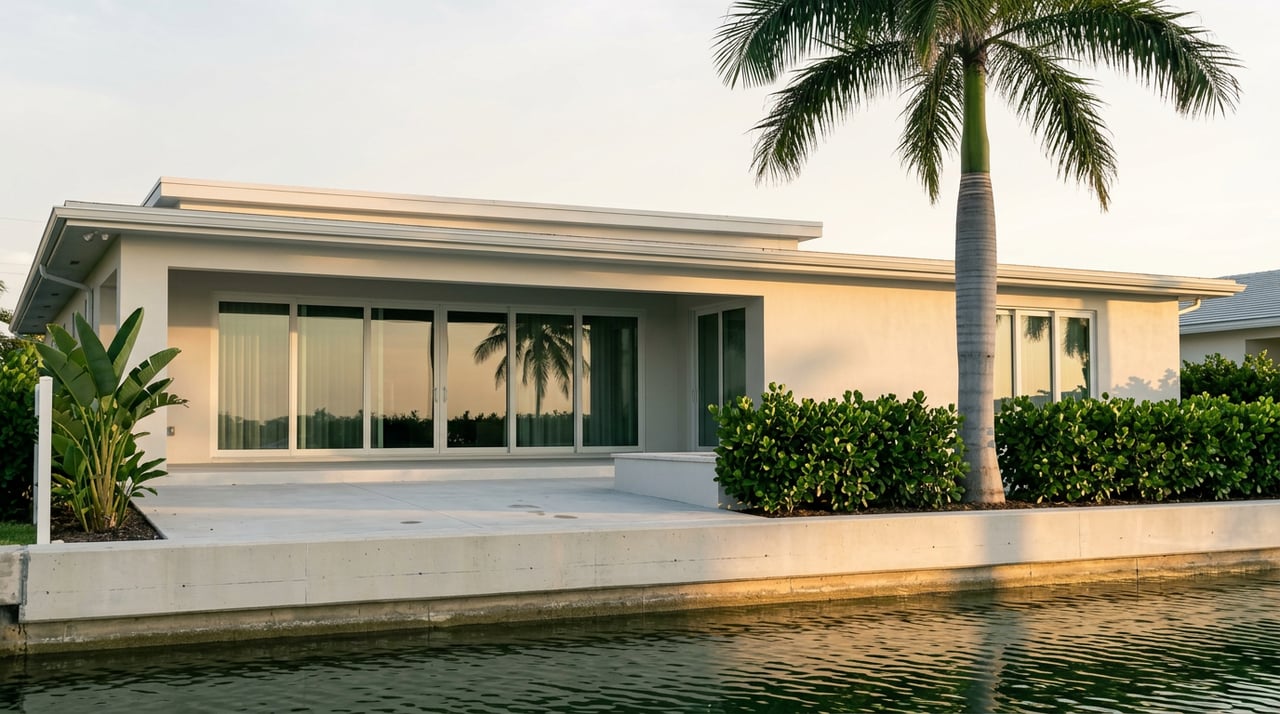
Picture a seawall along one of Fort Lauderdale's canal-front streets. It has held for four decades, the kind of structure a listing photo never shows because there is nothing dramatic to photograph. Then a buyer's marine engineer walks the property line during due diligence and flags cracking along roughly two-thirds of its length. The contractor's recommendation seems simple: patch the damaged run, leave the rest alone, close on schedule.
It is not that simple, and the reason has nothing to do with the seawall's age or the size of the crack. It has to do with a single number written into Broward County's flood resiliency code: 50 percent.
The date everyone has memorized
Ask most Fort Lauderdale waterfront owners when their seawall needs to meet the new elevation standard and you'll get a year, not a rule. Broward County's regional policy, adopted under Policy 2.21.7 and Chapter 39, Article XXV of the county code, phases in a minimum top elevation of 4.0 feet NAVD88 by January 1, 2035, rising to 5.0 feet NAVD88 by 2050. That timeline gets repeated in enough marketing material that it has become the default mental model: there's a decade to plan, no urgency, worry about it later.
Fort Lauderdale never waited for the county's phased schedule. On March 23, 2023, the city commission adopted its own tidal flood barrier ordinance, raising the minimum required top elevation from 3.9 feet to 5.0 feet NAVD88, effective immediately for new and substantially repaired seawalls. The city had already been building its own municipal seawalls to a 5-foot standard for several years before the ordinance made it official policy for private property. The 2035 date that shows up in county planning documents is not Fort Lauderdale's compliance deadline. It's the deadline for cities that haven't already acted. Fort Lauderdale has.
The date that actually governs your transaction
Here is the part that catches owners and buyers off guard: the 5-foot standard does not wait for a calendar to arrive. It arrives the moment a repair crosses a defined threshold.
Under the resiliency code, a "substantial repair" is any work that affects more than 50 percent of a seawall's length, or any work that changes the elevation along more than half of it. Cross that line, and the code treats the entire wall as new construction. The whole structure, not just the damaged section, has to come up to the current 5.0-foot NAVD88 standard. A contractor who quotes a $20,000 patch on a portion of the wall may come back with a $100,000 or larger full-replacement scope once an engineer's assessment confirms the repair touches more than half the length.
One marine contractor working the Broward waterfront put it bluntly in a statement earlier this year: the real trigger isn't the year on the county's compliance chart, it's "the day an owner decides to fix more than half of their wall." Once that happens, the whole structure has to meet code, planned or not.
There's a third trigger too, separate from voluntary repair. If code enforcement issues a citation for a seawall that's failing or causing flooding on neighboring property, the owner gets a 365-day window to design, permit, and construct a compliant replacement. That clock starts on the citation date, not on a negotiated timeline.
| Trigger | What it requires | Timing |
|---|---|---|
| New seawall construction | Meet 5.0 ft NAVD88 now | Before permit issuance |
| Substantial repair (over 50% of length or elevation change) | Entire wall brought to 5.0 ft NAVD88 | Before permit issuance |
| Code enforcement citation | Full compliant replacement | 365 days from citation |
What this means before you write an offer
For a buyer, the practical question isn't "does the seawall look fine." It's "how much of this wall would an engineer classify as needing repair, and does that number cross 50 percent." A wall that looks 70 percent sound and 30 percent damaged is a manageable repair. A wall that's 55 percent damaged is, legally, a full replacement project the moment anyone touches it. Two seawalls that look nearly identical from the dock can sit on opposite sides of that line, and only an engineer's linear measurement tells you which one you're buying.
For a seller, the same math changes what you can safely leave undisclosed. Since December 31, 2020, sellers of real estate in tidally influenced areas of Broward County have been required to disclose in writing that the property may be subject to minimum tidal flood barrier elevation standards. That disclosure exists precisely because most standard home inspections don't evaluate seawalls at all. The responsibility for surfacing the wall's real condition sits with a separate marine or structural engineer, commissioned specifically for that purpose, and the disclosure requirement means a seller can't simply let a buyer discover the 50 percent threshold after closing.
There's also a cost-logic worth knowing before you negotiate repair credits. Contractors who work this market regularly note that once a repair's cost approaches roughly half the cost of full replacement, replacement is usually the better capital decision anyway. A patched wall rarely outlasts fifteen years, while an engineered replacement built to current standards typically runs thirty to fifty. Regional planning studies used in resiliency analyses put average full seawall replacement at roughly $1,320 per linear foot, with raising an existing compliant wall estimated around $120 per linear foot. Local market guides citing actual contractor quotes for full residential seawall replacement or repair generally land somewhere between $20,000 and $100,000 or more, depending on wall length, material, and site access. The range is wide because the inputs are wide: a 60-foot vinyl sheet pile job in a calm canal costs nothing like a 150-foot concrete wall exposed to open water and boat wake.
The permitting stack that decides your timeline
Even once you know what needs to happen, getting there involves more than one office. A seawall project along Fort Lauderdale's waterways typically has to clear:
- City of Fort Lauderdale building and marine permitting, which reviews the wall against local waterway ordinance standards, setbacks, and the 5.0-foot elevation requirement.
- Broward County, which licenses seawall contractors and reviews compliance with the countywide resiliency code.
- The Florida Department of Environmental Protection, through a Joint Coastal Permit or Environmental Resource Permit for any work affecting state waters. This step alone can take six to twelve months.
- The U.S. Army Corps of Engineers, when work touches navigable waterways, which most Fort Lauderdale canals do.
That's four agencies with independent review clocks, which is why a seawall project that a homeowner budgets as a two-month job can stretch well past a year once permitting is added in. If a citation has already been issued, that 365-day compliance window is running against a permitting process that can itself consume most of a year.
A real example of what compliant work looks like
Fort Lauderdale's own Southeast Isles seawall replacement project, along Las Olas Isles, shows the standard in practice rather than on paper. The city rebuilt seawall segments there with a cap elevation of 5 feet NAVD88, alongside new stormwater infrastructure, to reduce tidal flooding along Las Olas Boulevard. Construction on various segments began in the fall of 2023 and wrapped by the following summer, with work staged section by section and boat traffic restricted from the canal during pile-driving phases. It's a useful reference point for what a fully compliant seawall now looks like along one of the same tidally influenced corridors that originally anchored the Army Corps and Broward County flood study.
How to price this before you're under contract
If you're evaluating a canal-front home in Las Olas Isles, Rio Vista Isles, Isla Bahia, Sunrise Key, Coral Ridge, or Harbor Beach, ask for three things before you write an offer: a current marine engineer's condition assessment with a linear measurement of damage, not just a visual description; the wall's documented top elevation in NAVD88, which a licensed surveyor can confirm; and any prior permits or citations on file with the city or county. If you're selling, get that same assessment done before you list, so the disclosure you're required to provide is based on an actual number rather than a guess.
Short FAQ
Does raising my seawall lower my flood insurance premium? Not automatically. Flood insurance premiums are driven primarily by your building's elevation relative to FEMA's Base Flood Elevation and your flood zone designation, which are evaluated separately from the seawall's NAVD88 elevation.
Is my existing seawall grandfathered if it's below 5.0 feet? Generally yes, until you build new, trigger a substantial repair, or receive a citation. A licensed surveyor and marine engineer can confirm your wall's status and whether any deadline applies to your specific property.
Who actually measures whether a repair crosses the 50 percent threshold? A licensed marine or structural engineer typically performs this assessment as part of a condition report, measuring damage against the wall's total linear footage or the total repair cost against full replacement cost.
Waterfront transactions in Fort Lauderdale carry more moving parts than the listing photos ever suggest, and the seawall clock is one of the pieces that only shows up once someone starts measuring. If you're weighing a canal-front purchase or getting ready to list one, Pilar Ruiz Homes can walk you through what a specific property's seawall history and documentation actually show before you're locked into a contract. Schedule a private consultation with Pilar to review the numbers on your specific address.
