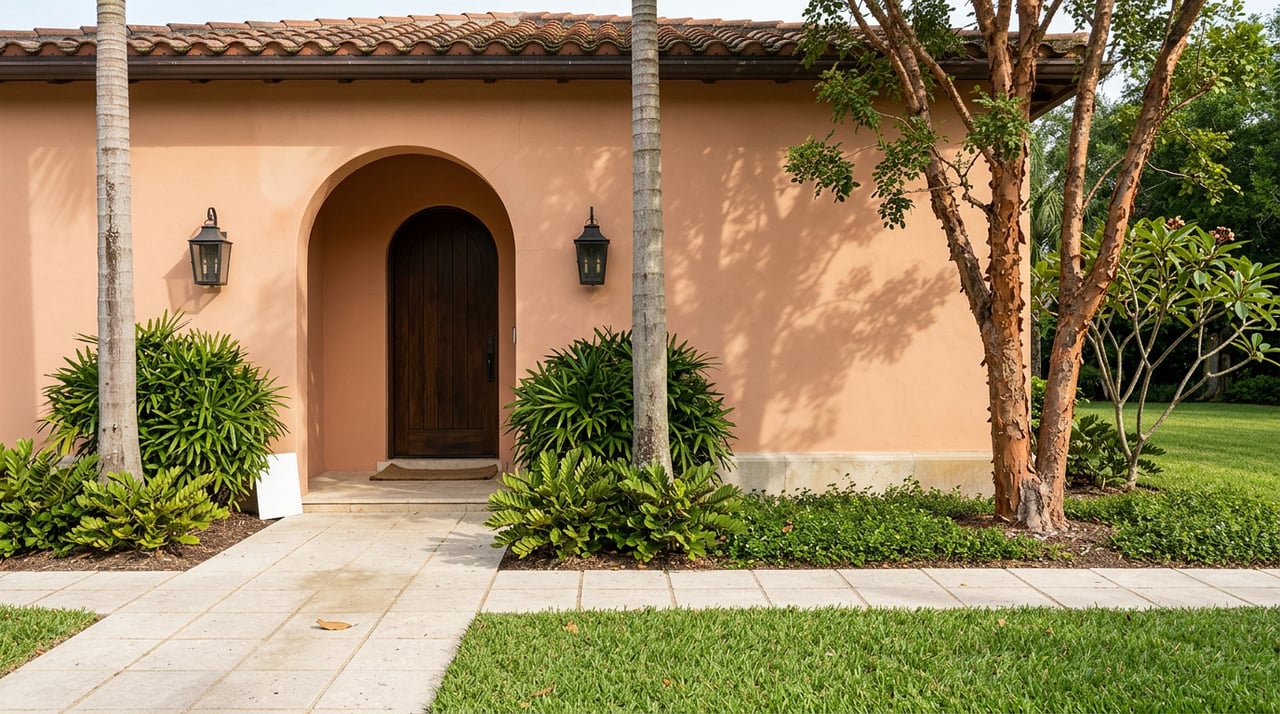
On May 5, 2026, an heiress to the Sedano's Supermarkets fortune closed on her Pinecrest estate at 10101 SW 60th Court for $13.4 million, a 7-bedroom, 11,500-square-foot house on a one-acre lot that had last traded for $1.7 million in 2006, as The Real Deal first reported. That same week, a 4-bedroom ranch on a comparable acre a few blocks away sat on the market at a fraction of the number, waiting for a developer.
Both properties are "Pinecrest." Both sit inside the same ZIP code, the same village, the same school-attendance boundaries. Neither one is priced against the other. If you are shopping the neighborhood in mid-2026 and using the citywide median as your compass, you are already lost.
Two Pinecrests, priced on different units
The village behaves as two overlapping markets on the same street grid. The first is a land-value tier: original 1960s–1980s ranch houses on lots of 30,000 to 45,000 square feet, priced primarily on what the dirt is worth to a builder. The second is a finished-product tier: new-construction or fully rebuilt estates priced on delivered square footage and finish level, most of them concrete-structure two-story homes of 8,000 to 12,000 square feet with pools, theaters, elevators, and generator-ready systems.
The distinction is not academic. It changes the unit of account.
| Tier | Typical asset | 2026 asking range | Priced on | Typical buyer |
|---|---|---|---|---|
| Land-value | 3–4 bed ranch, 2,500–3,500 sf, acre-plus lot | ~$2.0M–$3.5M | Price per usable acre, minus demolition | Builder, or end-user planning to rebuild |
| Renovation | Updated 1980s–2000s house, 3,500–6,000 sf | ~$3.5M–$7M | Blend: land + livable square footage | Family that wants a house now |
| Finished-product | New-build estate, 8,000–12,000+ sf on ≥1 acre | ~$7M–$22M+ | Price per finished square foot at $700–$1,100 | Cash buyer, often relocating from a condo |
Active inventory on the top end illustrates the gap. Public luxury search feeds this spring showed asking prices at 5771 SW 94th Street at $22.5 million, 5801 Moss Ranch Road at $19.8 million, and new-construction listings at 5901 SW 107th Street and 5900 SW 129th Terrace clustered near $17 million. Meanwhile, the Rocket Homes market report pegged the June 2025 Pinecrest median at $2.4 million at $743 per square foot, and Movoto's June 2025 cut showed a median closer to $3.165 million at $810 per square foot. Both numbers are technically correct. Neither describes any actual house you will tour.
Why the median has become useless in 2026
Redfin's November 2025 read placed the Pinecrest median sale price at $3.4 million and days on market at 134, compared with 121 the year before, on 18 recorded sales for the month. Movoto's June 2025 pull put average time on market at 100 days versus 70 a year earlier. Zillow's home value index for the same footprint sat around $1.81 million, up 9.2 percent year over year.
Those four numbers describe the same neighborhood and disagree by a factor of nearly two. The reason is the tier mix in whatever slice of transactions each source measures. A month in which two $15 million new-builds close and three tired ranch houses do not will produce a very different median than a month in which the opposite happens. This is why a Pinecrest seller who prices to a headline number, and a Pinecrest buyer who negotiates against one, are both trading on data that has no bearing on the specific house between them.
The longer time on market is not evenly distributed either. New-construction spec estates are the ones sitting. Individual new-build listings pulled from public feeds this spring showed 111, 129, 147, 198, and 308 days on Zillow at asking prices between $4.5 million and $11.9 million. Land-value teardowns, by contrast, move to contract in weeks when priced against dirt comps rather than house comps.
The zoning floor under everything
Much of Pinecrest sits under Miami-Dade's EU-1 Single-Family One-Acre Estate framework, which caps lot coverage at 15 percent of net lot area and permits one single-family residence per one-acre lot. Portions of the village apply comparable one-acre minimums under village code. The practical effect for a buyer is that new supply cannot arrive at density. Every future estate is one house on one acre, delivered by one builder, roughly nine to twelve months from permit-ready plans to certificate of occupancy in the current Florida labor market.
That is the structural reason the land-value tier holds a floor even in a slower market. A builder who can carry the land is not selling to a retail buyer at a discount. A retail buyer who wins a teardown pays close to land value and then absorbs 18 to 24 months of build risk. The two pricing logics rarely meet in the middle.
What actually catches buyers and sellers off guard
Transaction friction in Pinecrest tends to hide inside these five points:
- You are buying an acre first and a house second. On the land-value tier, a well-run appraisal will separate lot value from improvements. Financing on a house the appraiser flags as functionally obsolete can look very different from what the listing agent implied.
- Insurance and impact-glass status often move monthly cost more than the asking price. Roof age, opening protection, and wind-mitigation reports change premium quotes in five figures per year on estate-scale houses. A number that felt fine in underwriting can move materially between contract and closing.
- Comps have to be tier-matched, not just geography-matched. A finished-product comp two streets over is not a comp for a 1978 ranch, and vice versa. Portal AVMs blend both and produce a number that fits neither.
- New-construction contracts carry delivery risk. Several 2026 Pinecrest new-builds have relisted or reduced during construction. Deposits, change-order procedures, and delivery-date remedies belong in the contract at signing, not at drywall.
- Cash buyers set the pace at the top. Cash accounted for roughly 40 to 43 percent of Miami luxury sales in early 2025, per industry reporting. A financed offer above $7 million in Pinecrest is not disqualified, but it competes against contracts that skip the appraisal and financing contingencies entirely.
How to price against the right comp set
For a seller on the land-value tier, the correct comparable is the last three teardown or renovation-buyer sales within a half-mile, adjusted for lot square footage, corner-lot status, and canopy. What the finished-product listing down the street is asking is not evidence.
For a seller on the finished-product tier, the correct comparable is delivered new-construction sales within the last nine months, adjusted for architect, structural system (full concrete versus block-and-frame), and level of custom millwork. Named builders and architects behind recent Pinecrest deliveries include GILU Development with Borges Architects and landscape architect Matthew Lewis of LandDesign, Pacheco Architecture, Hollub Group, and ADZ Homes. A finished estate by a recognized team trades against other finished estates by recognized teams, not against spec inventory that has been sitting.
For a buyer, the discipline is to decide before you tour which tier you are shopping. Touring both is educational and expensive.
A short FAQ
Is Pinecrest a buyer's market or a seller's market in mid-2026? It is neither, cleanly. The land-value tier is close to balanced with limited teardown-quality supply. The finished-product tier above roughly $7 million has more inventory than buyers at current asking levels, which is why several new-construction listings have crossed 200 days.
How much does the recent Santana sale at $13.4 million tell me about my house? Only if your house is a 2011-built, 11,500-square-foot finished estate on a full acre with a pool and comparable amenities. If it is not, the number is context, not a comp.
Should I wait for prices to drop? The land-value tier is anchored by replacement cost and a zoning-constrained supply of acre lots. The finished-product tier can and does discount on individual listings. Waiting is a strategy on a specific house, not on the neighborhood.
Who is actually buying at the top right now? Reporting from the past year describes a mix of established local families, executives relocating out of condo lifestyles, and cross-border buyers using cash. Financing plays a larger role in the $3–$6 million band than above it.
Pricing a Pinecrest home, whether you are the buyer writing the offer or the owner setting the list price, is a question of which market you are actually in. Pilar Ruiz de la Torre works both tiers of that market, on both sides of the transaction, with full Coldwell Banker Global Luxury syndication behind the marketing and multilingual support for cross-border buyers. To have a private conversation about a specific address or a target block in Pinecrest, schedule a private consultation with Pilar at Pilar Ruiz Homes.
